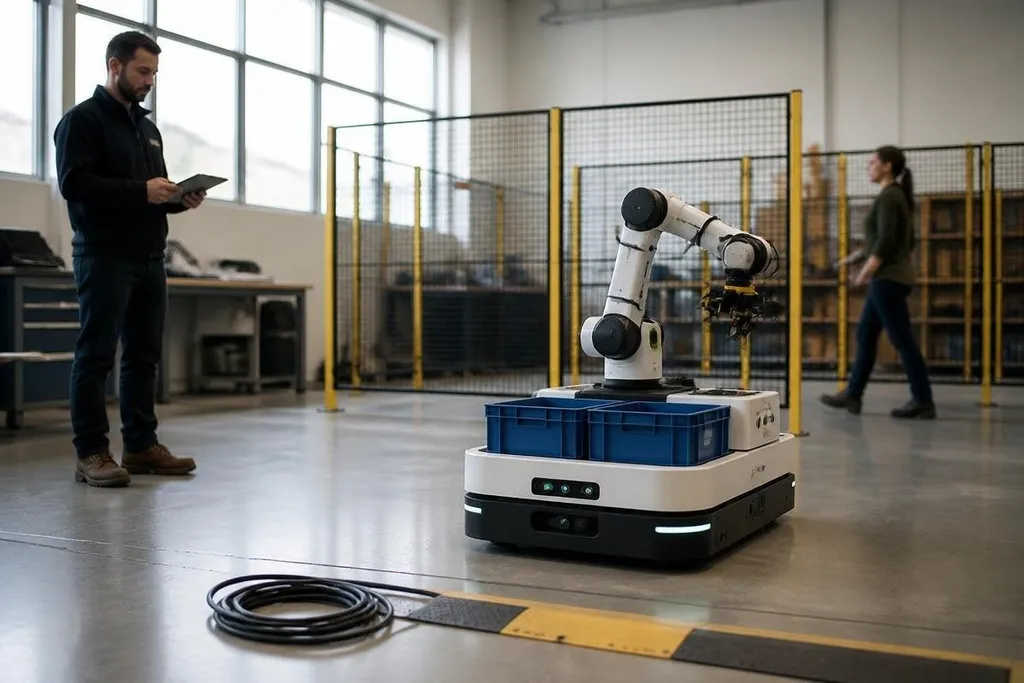
A robot can complete a task in a lab and still fail when a person, loose cable, or blocked route enters the scene. The test plan moves from software checks to controlled trials and supervised work.
This process matters because a deployment failure can stop a line, damage stock, or put people near moving hardware. The aim is to find weak points while the robot is still easy to change.
Quick read
- Simulation checks motion and software before hardware runs
- Hardware tests expose sensor, motor, battery, and grip faults
- A supervised pilot shows whether the robot fits the real task
Start with software and simulation
The first tests often run without a full robot moving through a work area. Engineers check code, motion plans, sensor inputs, and control rules in a simulated setting. The robot can repeat the same task many times without wearing parts or putting people at risk.
Simulation is useful for testing cases that are hard to stage by hand. A virtual robot can meet an obstacle, lose a sensor signal, miss a target, or receive an incorrect position. Engineers then check whether the software stops, retries, or chooses a safe route.
Simulation has limits. A virtual gripper does not have the same contact with a real box, and a simulated floor does not show every slip or bump. Results from this stage narrow the risks; they don't prove that the robot is ready for work.
Test the hardware one part at a time
Next, the physical robot runs under controlled conditions. Motors run through their range, joints move under load, cameras and other sensors receive known inputs, and the battery system is checked during normal operation.
The team also checks the robot's end effector, the part that touches the object. A gripper may close at the right position but still fail when a box is soft, heavy, wet, or slightly misplaced. That is why object handling needs repeated trials with the materials the robot will meet after deployment.
Logs matter during these tests. They record commands, sensor readings, motor state, battery data, and stops. When a robot fails, the log helps engineers separate a software error from a bad sensor reading or a mechanical fault.
Safety checks run alongside the technical work. The team tests emergency stops, speed limits, protective scanners, warning signals, and restart behavior. A safe stop must leave the robot in a known state, and restarting must require the conditions set by the site's safety plan.
Test the full system around people
A robot rarely works alone. It may share space with workers, conveyors, shelves, doors, lifts, or other machines. Engineers test the whole system with the same handoff points, routes, charging method, and work instructions planned for the site.
The team introduces controlled changes to the task. A box is placed outside its usual position. A route is blocked. A person enters the work area. The point is to see whether the robot detects the change and selects the right response, rather than completing the planned motion at any cost.
Those changed-task checks show whether the robot can react when the work no longer matches its planned path. Reports from Robot24.com can place that result beside the named machine, test setting, and deployment claim. The supervised pilot then checks whether the same response holds during live work.
A supervised pilot comes next. Operators watch the robot during live work, record failures, and check how often people need to intervene.
The team also measures setup time, recovery time, maintenance needs, and the quality of the robot's output. A pilot should have a clear stopping rule.
If the robot creates an unsafe condition, damages goods, or needs too much manual help, the test pauses while engineers fix the cause. A successful demo is useful evidence, but it is only one part of the decision.
What to check before deployment
Use this checklist when reviewing a robot for a real task:
- Define the task: list the objects, routes, speeds, handoffs, and work hours the robot must handle.
- Test normal work: run repeated cycles with the real materials and tools.
- Add failures: block routes, move objects, interrupt sensors, and test empty or low-battery states.
- Check people safety: verify stops, scanner zones, warning signals, and restart rules.
- Review the logs: record what failed, how often it failed, and how long recovery took.
- Set a pilot gate: decide which results allow wider use and which results require more testing.
I'd reject any deployment plan that treats a smooth demonstration as proof of reliable work. The better question is whether the robot can detect ordinary problems, stop safely, and recover without constant help.
Before the robot moves into daily service, engineers still need an answer to one practical question: how much supervision will the task require after the test team leaves?